
The FOCAL Project has held its Second Training School!
The 2nd Training School took place on two of the partners’ premises: Airbus Netherlands and TNO. A perfect occasion to envisage the different aspects and applications of research.
14th of April: At TNO premises in Delft
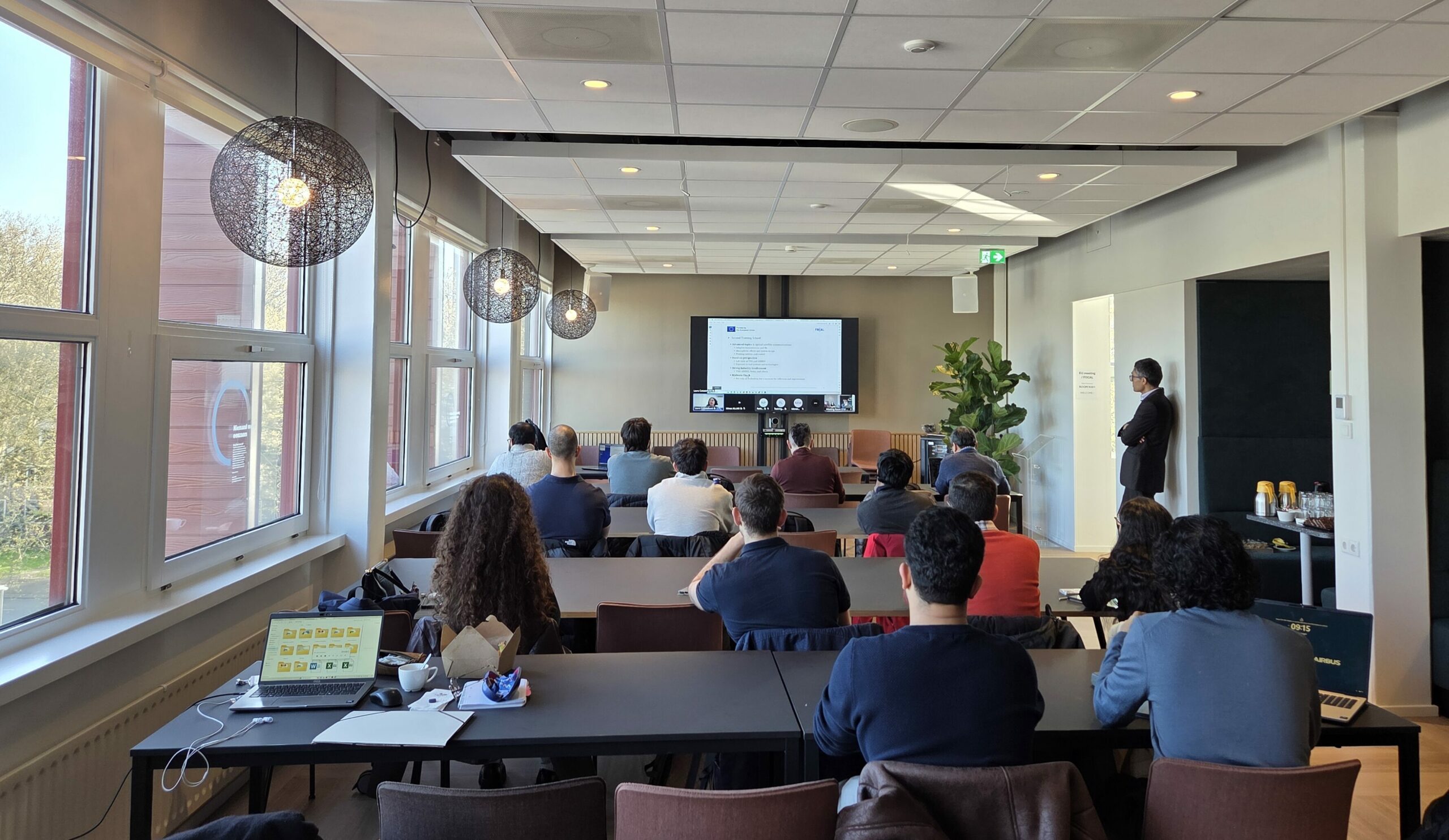
Fary Ghassemlooy (Emeritus Professor, Northumbria University at Newcastle, NUN), Hoa Le Minh (Professor, NUN): “Adaptive transmission and SD signalling”
The speakers presented advanced transmission techniques for next-generation optical wireless and satellite communication systems. The tutorial introduced the principles of adaptive transmission and signal design strategies. Particular emphasis was placed on adaptive modulation and coding, spatial and signal-domain (SD) signalling techniques, and the mitigation of impairments. The presentation further discussed the integration of these techniques within high-capacity optical wireless and non-terrestrial communication networks.
Roberto Ferrara (Quantum Scientist, Technische Universität Braunschweig, Germany): “Superdense coding with high noise and low energy”
The speaker provided an advanced introduction to quantum information theory and entanglement-assisted communications. The tutorial reviewed key concepts of quantum information, including quantum entropy, entanglement measures, classical-quantum systems, and quantum channel capacities, before discussing entanglement-assisted classical capacity and its relation to super-dense coding. The presentation also discussed practical implications for future quantum and optical communication networks.
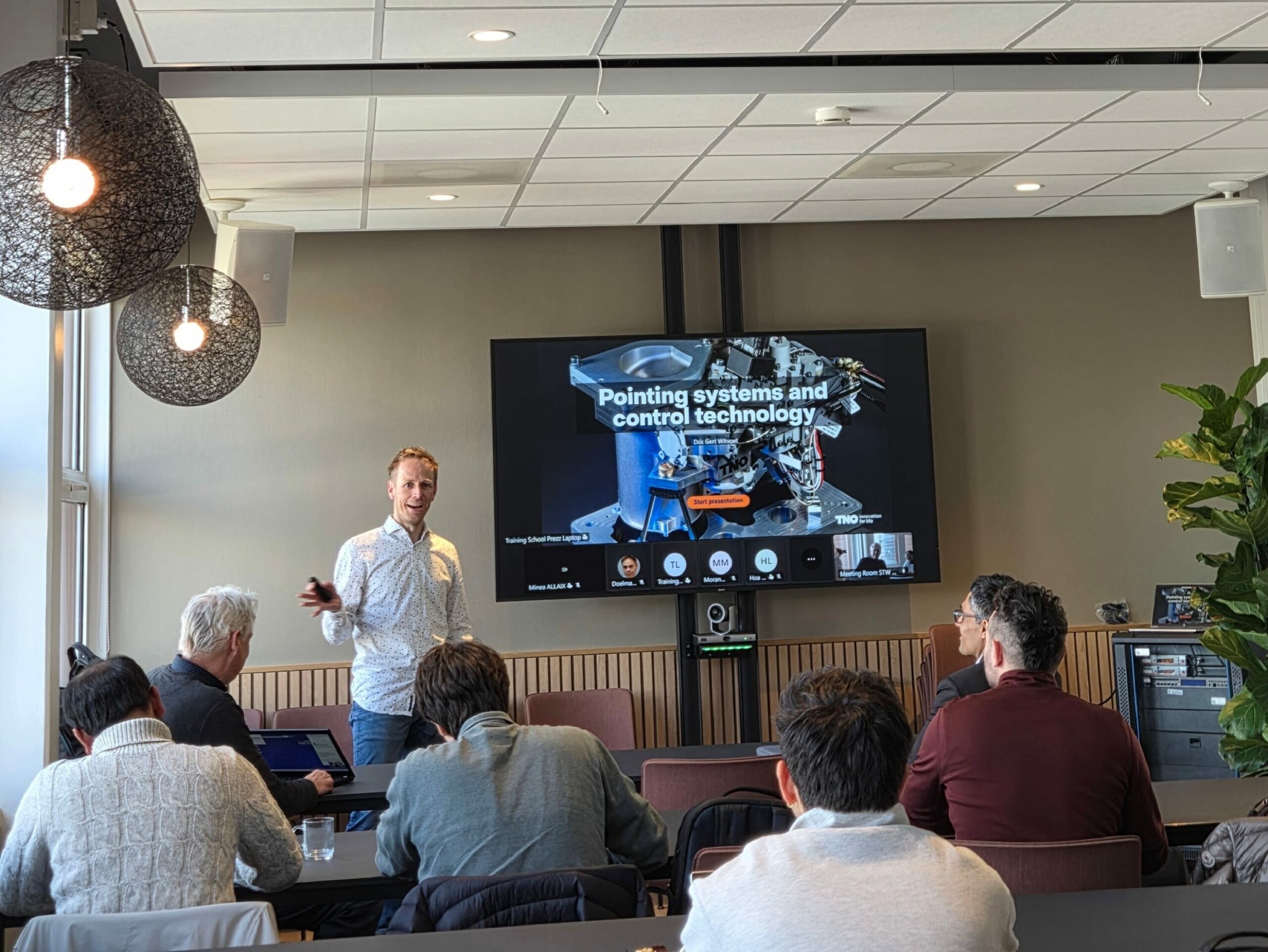
Gert Witvoet (Senior Researcher at TNO, Associate Professor at Eindhoven University of Technology, TU/e, Netherlands): “Pointing systems and control technology- part 1/2”
The speaker addressed the principles, challenges, and technological solutions underlying high-precision pointing and control systems for optical and free-space communication applications. The lectures introduced the role of advanced optomechatronic and motion-control technologies in enabling reliable high-capacity optical communication links between satellites and ground stations. The presentations discussed the design and control of coarse and fine pointing assemblies, beam steering mechanisms, pointing jitter mitigation, adaptive control strategies, and sensor calibration techniques. The talks further illustrated these concepts through examples and developments from TNO and TU Eindhoven related to optical satellite communications, adaptive optics and CubeSat optical terminals.
Alexis Dowhuszko (Associate Professor at Aalto University, Finland): “AI/ML in Satellite Communication Networks”
The speaker provided an overview of the challenges and opportunities associated with the application of Artificial Intelligence (AI) and Machine Learning (ML) techniques to future non-terrestrial and satellite communication networks, with particular focus on LEO mega-constellations and optical inter-satellite links. The tutorial introduced the evolution toward integrated terrestrial and non-terrestrial 5G-Advanced and 6G systems, highlighting key challenges related to mobility, routing, spectrum management, channel estimation, and free space optic (FSO) link acquisition. Several AI/ML models and architectures were presented through practical case studies addressing autonomous and driven control in autonomous NTNs, collision avoidance, routing optimization, adaptive pointing and tracking, resource allocation, channel estimation and signal detection in next-generation satellite communication systems.
15th of April: At TNO premises in Delft
Wim Korevaar (Senior Researcher at TNO, Netherlands): “From Photons to Bits – FSO communication system design”
The lecture addressed the fundamental principles and system-level design aspects of FSO communication systems for terrestrial and satellite applications. The tutorial introduced the end-to-end design chain of FSO systems, from optical signal generation and propagation to detection, modulation, coding, and digital signal processing techniques required for reliable high-capacity data transmission. Particular emphasis was placed on the challenges affecting practical FSO links. The presentation further discussed recent developments and experimental activities carried out at TNO in collaboration with industrial and academic partners.
Remco den Breeje (Systems Engineer, Airbus Netherlands): “Maritime Communication terminal – systems engineering aspects”
The speaker presented the system-level design challenges and elaborated on engineering aspects involved in the development of advanced optical communication terminals for maritime applications. The tutorial introduced the role of laser-based FSO communication technologies in enabling secure, high-capacity maritime connectivity for future satellite communication networks. The presentation further discussed the interaction between optical ground stations, satellite communication systems, and mobile maritime platforms, highlighting current developments at Airbus in optical communication terminals.
Sébastien Bigo (Senior Researcher, NOKIA Bell Labs, France): “Coherent long-range optical communication technology”
The lecture introduced the fundamental principles and technological evolution of digital coherent optical communication systems, with a particular focus on their role in future high-capacity terrestrial and satellite networks. The presentation further illustrated how these technologies jointly enabled the evolution from 100 Gbit/s systems toward Tb/s optical communications and highlighted emerging applications in optical satellite networks and optical sensing. Finally, the tutorial provided insights into current research activities at Nokia Bell Labs France.
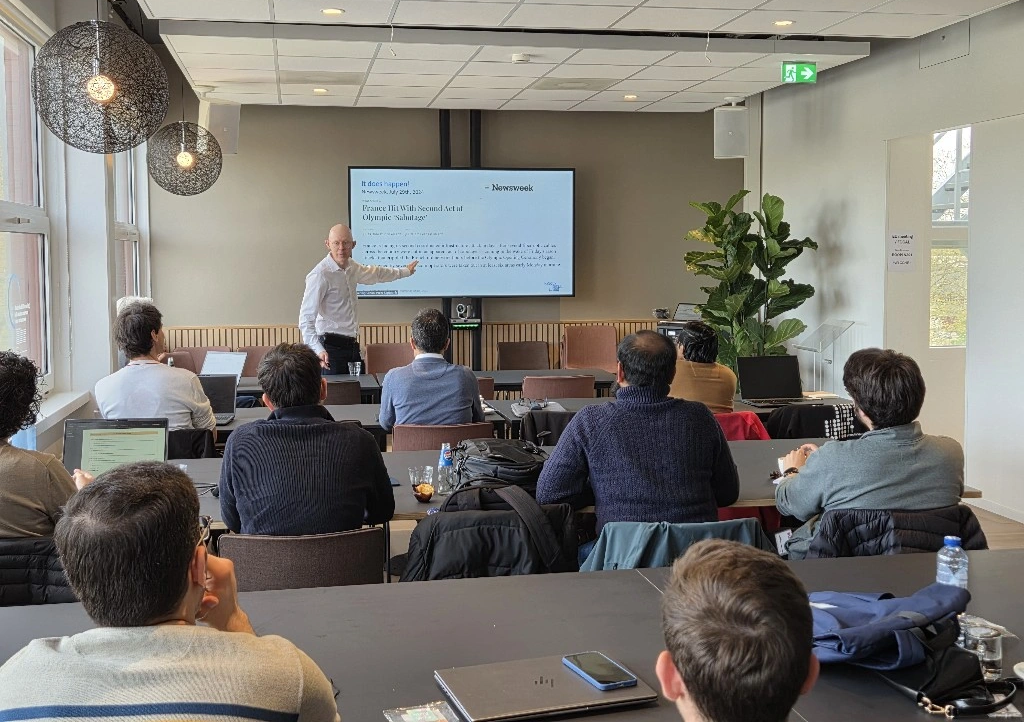
16th of April: At Airbus Netherlands premises in Leiden
Majid Safari (Professor, University of Edinburgh, UK): “Spatial mode multiplexed FSO transmission”
The speaker provided an overview on the fundamentals of FSO communications and the main channel impairments. The presentation further addressed diversity and multiplexing techniques for turbulent FSO channels, the impact of atmospheric turbulence and channel correlation, as well as mitigation strategies.
Francesco Vedovato (Senior Researcher, University of Padova, ThinkQuantum Co., Italy): “Technology for QKD space links”
The speaker provided an overview of the principles, challenges, and current developments of space-based QKD systems for secure global communications. The tutorial introduced the fundamentals of quantum communications and QKD protocols. The presentation further discussed satellite-to-ground link-budget modelling. In addition, several practical implementations of satellite QKD systems were reviewed, including the Chinese Micius and Jinan missions, as well as current European initiatives such as the ESA Eagle-1 project. Finally, the presentation addressed ongoing technological challenges related to optical ground stations, synchronization, interferometric stabilization, and free-space optical quantum links for future secure global communication networks.
Visit to optical communications lab, Airbus
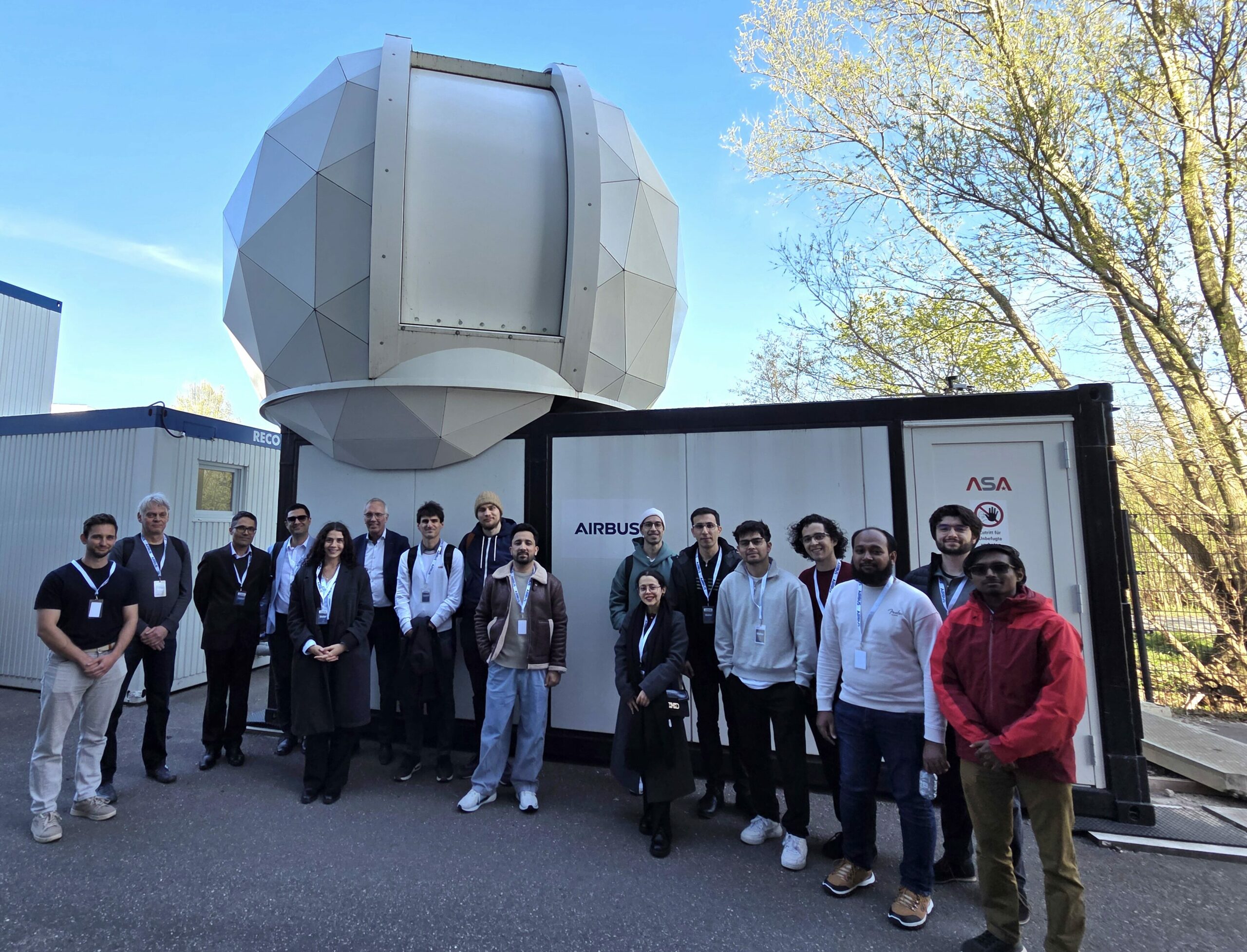
A rich moment of scientific cooperation: The attendees of the 2nd FOCAL Training school
In addition to these interesting presentations, the 2nd Training School gathered a lot of members of the Consortium.
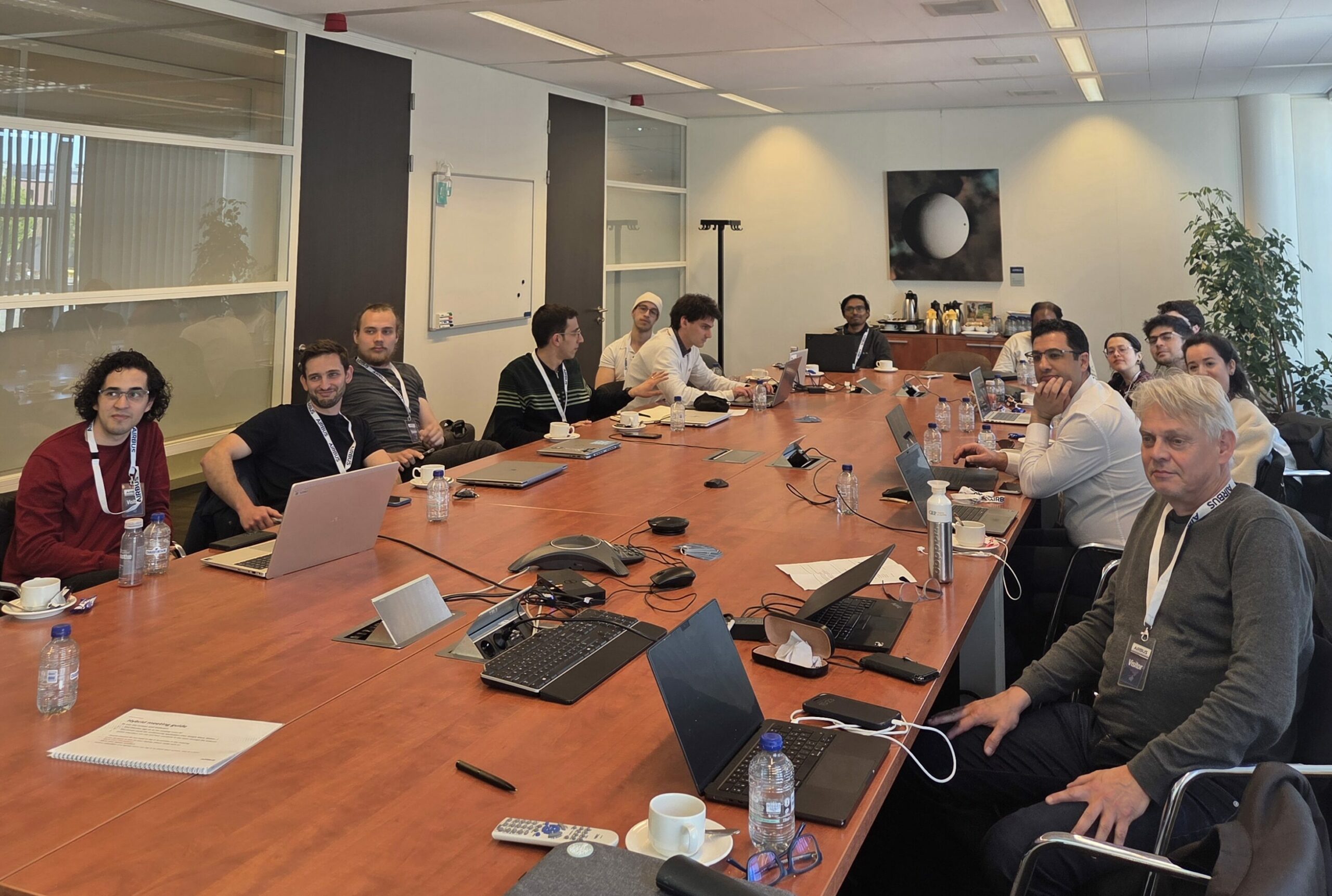
Professors and researchers
We were delighted to have amongst us:
Davide ORSUCCI (DLR):Researcher affiliated to DLR – German Aerospace Center (Institute of Communications and Navigation) & University of Innsbruck (Department of Theoretical Physics).
Niek DOELMAN (TNO): Principal Scientist at TNO and High-Tech Industry Professor at Eindhoven University of Technology.
Ali Khalighi: Associate professor from Ecole Centrale Marseille and the Fresnel Institute; and FOCAL Project coordinator.
Laura Cottatellucci: Associate professor for the Department of Electrical-Electronic-Communication Engineering at Friedrich-Alexander University of Erlangen-Nuremberg.
The Doctoral candidates
This Second Training School was a moment for the doctoral candidates to meet and to train! We had the chance to meet:
- Abid AFRIDI: At Aalto University
- Xhelja KODHELI: At NOKIA-DK and AAU
- Mauricio SOTELO GONZÁLEZ: At Airbus Netherlands and TUe
- Dinesh UMASANKAR: At Nokia France
- Agustin GONZALEZ URIARTE: At Ecole Centrale Marseille
- Arturo MORALES BUGUEÑO: At TNO
- Ferdaous TARHNOUNI: At Friedrich-Alexander University of Erlangen-Nuremberg
- Mahmudul HASAN ABID: At Ecole Centrale Marseille
- Rodrigo KLOSTER ALBARRACIN: At TESAT and TUBs
- Mateusz MAZURKIEWICZ: At DLR
- Iker AVILA ARENAS: At ThinkQuantum and the University of Padova
- Amir Masoud JAFARPISHEH: At the University of Edinburgh
Thank you to the organizers:
Niek DOELMAN: Principal Scientist at TNO and High-Tech Industry Professor at Eindhoven University of Technology
Sytze KAMPEN: Head of Technology at Airbus Netherlands B.V.
Ali Khalighi: Associate professor from Ecole Centrale Marseille and the Fresnel Institute; and FOCAL Project coordinator.
Laura Cottatellucci: Associate professor for the Department of Electrical-Electronic-Communication Engineering at Friedrich-Alexander University of Erlangen-Nuremberg.
Minea Allaix: FOCAL Project manager.
We look forward to further meetings and training sessions! Stay tuned – and take a look at our Linked In. (https://www.linkedin.com/company/focal-msca-project/)
Research and more!
The Training School was also a convivial moment! We had the chance to share a diner at Delft! Science is also done during informal moment.
The two new Doctoral Candidates representatives have been elected, congratulations to: Ferdaous TARHNOUNI (Friedrich-Alexander University of Erlangen-Nuremberg) and Mahmudul HASAN ABID (Ecole Centrale Marseille)! A mixed team, we are more than proud!
What is next?
Our next meeting will be our first Industrial Days. DCs will benefit from in-depth knowledge and hands-on experience.
We will also publish new articles concerning our achievements and our contribution to research and innovation in Europe!