
DC9 – Mahmudul Hasan Abid
Ecole Centrale Mediterranee (ECM)
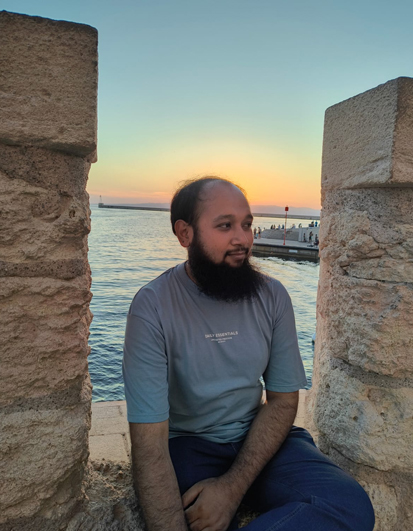
Mahmudul Hasan Abid is a doctoral researcher at École Centrale Méditerranée under the FOCAL MSCA Doctoral Network, working on integrated sensing and communication (ISAC) for resilient non-terrestrial networks (NTNs) using free-space optical (FSO) links. His research focuses on the design of feasible and efficient waveform schemes, channel estimation strategies, and AI-based models to enhance the robustness of optical wireless links under dynamic atmospheric conditions.
He earned his B.Sc. and M.Sc. in Electronics and Communication Engineering from Khulna University, Bangladesh, graduating first in class with distinction in both programs. In recognition of his academic excellence and research contributions, he has received multiple awards and scholarships throughout his academic career.
His previous research focused on advanced multicarrier modulation schemes for next-generation wireless and optical wireless communication (OWC). His broader research interests include wireless communication, optical communication, signal processing, multicarrier modulation, machine learning, and the internet of things (IoT). He has authored several peer-reviewed journal and conference papers, including publications in IEEE Wireless Communication Letters, IEEE Open Journal of the Communications Society, and IEEE Access.
DC9 – Project research
This thesis investigates integrated sensing and communication (ISAC) techniques for resilient non-terrestrial networks (NTNs) using free-space optical (FSO) links. The primary objective is to develop adaptive solutions that leverage real-time joint sensing and communication to maintain robust optical wireless links under dynamic atmospheric conditions. Special emphasis is given to the design of efficient waveform schemes, enabling both reliable data transmission and precise environmental sensing to extract key channel parameters. The research will also incorporate AI-based methods, especially for predictive channel modeling and real-time waveform adaptation, to meet the dynamic requirements of ISAC for optical NTN links. In the end, this work is expected to contribute to building resilient optical backbones in the sky-air-ground, aligned with the goals of the FOCAL MSCA Doctoral Networks project.